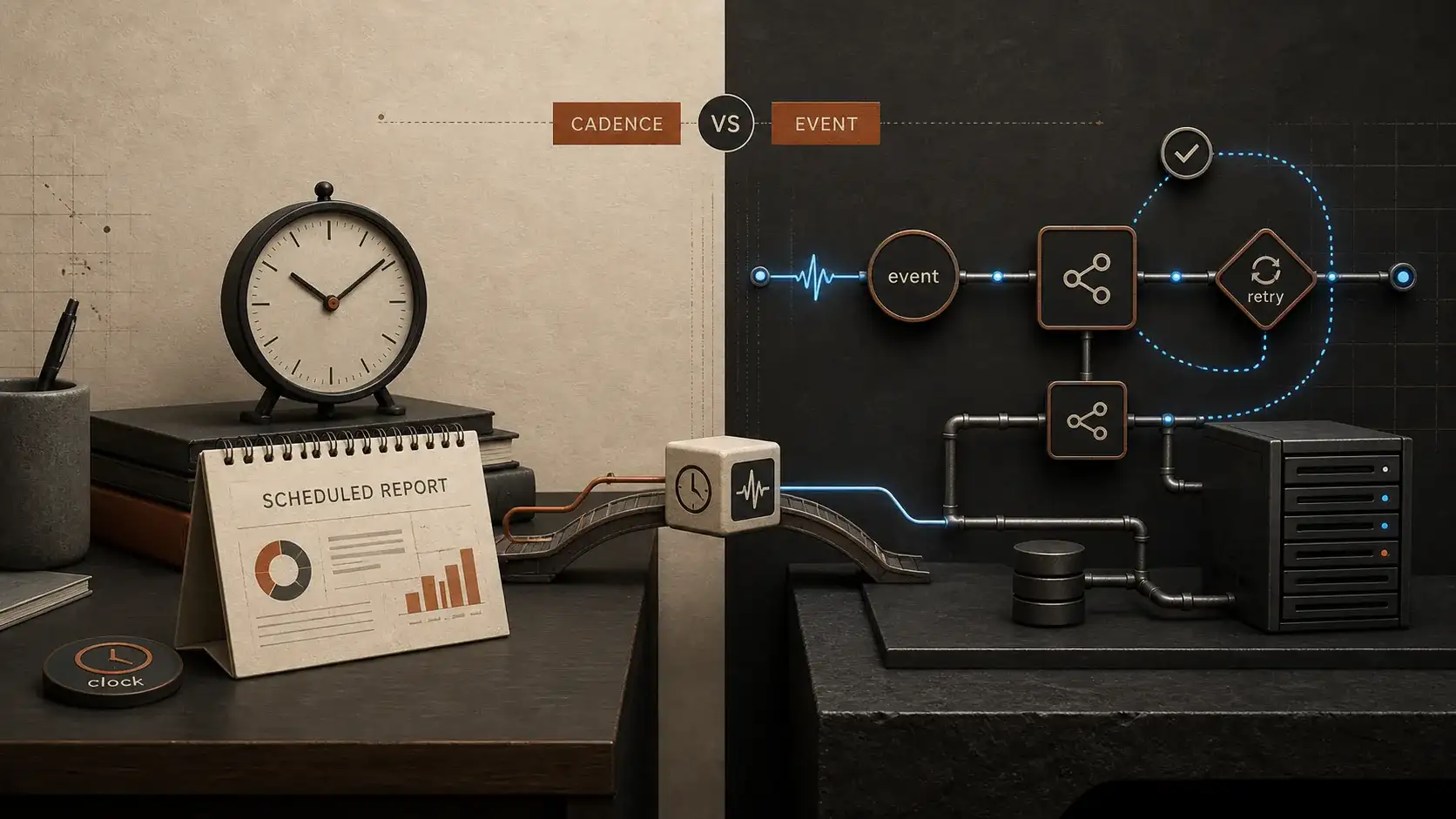
For most of 2026, the honest answer to "can Claude Cowork run my automation?" was "only while your laptop is awake." That stopped being true in July, when scheduled tasks moved onto Anthropic's own infrastructure.
This changes everything from what you have read so far, on several sites. The whole comparison needs to be redone.
Cowork now runs recurring knowledge work on a clock without your machine.
n8n runs event-driven processes on infrastructure your business owns.
What separates them in 2026 is the trigger: Cowork fires on a cadence you pick from a fixed list, n8n fires when something actually happens in your systems.
That distinction sounds academic until something goes wrong.
What Claude Cowork actually does
Cowork is the agent surface Anthropic built for people who, unlike me, do not live in a terminal. You hand it a task in plain language, it uses your connectors and your files to do the work, and it hands back a finished artifact: a finished report or a cleaned-up spreadsheet.
Scheduled tasks are the automation layer on top. You describe the job once, pick a cadence, and Claude runs it as its own Cowork session every time, with access to the same connectors, skills, and plugins you have set up. Per Anthropic's support documentation, they are available on all paid plans, and each run shows up in a "Scheduled" list where you can review it, pause it, change the cadence, or fire it on demand.
The output is genuinely good for the category it serves. A Monday morning brief that reads six tools and tells you the four things that changed is real work that used to eat somebody's first hour. You start your weekly work knowing what to do, good.
Does Cowork still need your laptop open?
No. Anthropic's help center states that scheduled tasks run remotely and fire on their cadence even when your computer is asleep, or the desktop app is closed, and results wait for you on desktop, web, or mobile.
There is one condition, though, and it is worth reading twice. Anthropic's setup instructions note that if a scheduled task requires local files or local apps, it only runs locally. The same page adds that remote scheduled tasks work with connectors and files saved to your Claude account, and cannot be tied to a folder on your computer.
So the old objection is dead for anything that requires only Slack, Drive, or a connector. It is alive and well for anything that reads a folder on your Mac. If you built a task around a local directory back in March, moving it to the cloud is a rewrite, not a toggle.
Where Cowork stops and n8n starts
Cowork tasks fire on a clock, and the built-in options are hourly, daily, weekdays, weekly, or on demand. n8n does that and also fires on events: an inbound webhook, a new row in a database, a failed payment, a form submission, a file landing in storage.
That is the difference that decides most architectures before cost ever enters the conversation.
Take the case I keep getting called about. A WooCommerce subscription renewal fails, the payment gateway sends a webhook, and something has to catch it, retry against the right endpoint, flag the customer, and tell a human if it still fails. I have written up how WooCommerce subscription webhooks break and what the failure modes look like in production. None of that is schedulable work. The event happens when it happens, and hourly polling means a customer can sit in a broken billing state for 59 minutes before anything notices.
Now run it the other way. "Every weekday at 8am, read yesterday's support tickets and tell me what people are angry about." Building that in n8n means a certain level of complexity that might look unnecessary. Cowork does it in a sentence, and does it better, because the judgment part is the whole task.
What each one costs to run
Cowork is included in Claude's paid plans, starting at $20 per month for Pro in the US, per Anthropic's help center. The catch is that Cowork draws from the same usage allocation as everything else you do with Claude, and Anthropic's own documentation warns that agentic task work consumes more of it than chatting does.
n8n prices per execution, where one execution is a full workflow run regardless of how many nodes it contains. Per n8n's pricing page, Cloud Starter is €24 per month for 2,500 executions and Pro is €60 for 10,000. The self-hosted Community Edition is free software with unlimited executions, and the final cost is a server somewhere in the $5 to $40 per month range depending on how hard you push it. I run it locally, so the cost is virtually zero.
Then there is cost per run, which is where the two diverge sharply. A deterministic n8n execution costs a fraction of a cent. A Cowork run is a full LLM session with tool calls, so it costs cents at minimum and considerably more when the task is doing real research.
Do the arithmetic on a poll. A workflow checking something every five minutes fires 8,640 times a month, which burns through the n8n Starter allowance in about nine days and costs a few dollars in compute if you self-host. The same volume of LLM sessions is a four-figure line item, and Cowork cannot even schedule it, because hourly is the floor. That floor caps one task at roughly 720 runs a month.
I broke down the per-run economics in more detail in the n8n vs OpenClaw vs Claude agents comparison, and the math has not moved.
Who owns the automation after the person leaves?
A Cowork scheduled task lives inside one person's Claude account, running against that person's connectors and that person's saved files. An n8n workflow lives on infrastructure the company controls, with credentials in shared storage and a workflow definition you can export as JSON and keep in version control.
For a solo consultant, the first model is fine. For a company, it is an offboarding problem waiting to happen. When the ops manager who set up the Friday revenue digest changes jobs, that task and its connector permissions leave with the account. Nobody else can open it or see why it stopped.
This is the part that rarely comes up in tool comparisons and always comes up in the second month of a client engagement. Automation that a business depends on should be inspectable by more than one person and recoverable when a number looks wrong. Cowork is not built for that job, and Anthropic does not claim it is.
The architecture that actually ships
Most of the systems I build end up hybrid, and they split along exactly the line above.
n8n handles the triggers, the retries, the API calls with known data shapes, and the writes into WordPress or the CRM. An LLM step sits inside the workflow for the one node that needs judgment, reading a keyword opportunity or drafting a section. For the content pipelines I have built for e-commerce clients, that structure cut cost per published post by 60 to 80 percent, and the team did not shrink. They stopped doing the mechanical parts.
Cowork sits beside that pipeline rather than inside it. It handles the work a human used to do on a Monday morning: reading the output and flagging what needs a human. I documented a version of that reporting layer in the e-commerce reporting automation write-up, and the division of labor has held up.
Two tools, one pipeline. Nobody is replacing anybody.
So which one do you build on?
The decision tree is short.
- Recurring knowledge work on a fixed cadence, with connectors, for one person → Cowork scheduled task.
- Anything that has to react to an event in under an hour → n8n.
- Anything a business depends on and needs to hand over or restore → n8n, self-hosted or cloud.
- High-volume deterministic runs where cost per execution matters → n8n, and it is not close.
- Judgment-heavy work with fuzzy inputs, running once a day → Cowork, with an n8n workflow feeding it clean data.
The July change removed a real limitation, and Cowork is a better product for it. What it did not do is turn a personal assistant into business infrastructure.
If you are trying to work out which parts of your operation belong in a Cowork task and which need to run as real infrastructure, that mapping exercise is exactly what n8n automation consulting covers. Tell me what you are running and I will tell you where the line is.