AI Customer Support Bot: RAG + WooCommerce Case Study
A WooCommerce support bot built with n8n, Pinecone and Claude. HelpScout tickets fell about 40% in the three months after launch.
A Canadian WooCommerce store selling regulated products was running about 20 HelpScout tickets a day. Most of them were the same five questions: where is my order, how do I use this, can I take it with my medication, what do you ship, how do I return it. The support team was spending its hours on answers that were already written down somewhere.
I built a support bot that answers those questions from the store's own documentation, checks live order status in WooCommerce, and hands the conversation to a human in HelpScout when it cannot answer. Every question it fails on gets logged, so the knowledge base grows where customers actually push on it.
What it does
Answers only from approved content
Product and company questions are answered from a Pinecone vector knowledge base. The model only answers on its own for greetings and small talk; for anything else, the knowledge base lookup is required. The corpus is curated by hand from official documentation, FAQs and product descriptions, then embedded with OpenAI embeddings. For a store where a wrong dosing answer is a compliance problem, this constraint is the whole point. The system prompt treats the knowledge base lookup as mandatory, and the agent is instructed to escalate instead of guessing when retrieval comes back thin. That's a rule in the prompt, not a hard guarantee, which is why the escalation path and the log below exist.
Looks up real orders
A customer can ask about their order inside the chat. The agent calls a WooCommerce sub-workflow that resolves the customer and returns a plain-language summary of their recent orders: status, dates, shipping address. Order data is only released to a logged-in customer whose email has been verified, so someone typing a stranger's address gets nothing.
Escalates with the full transcript
When the bot cannot answer with confidence, it offers to open a ticket. The HelpScout sub-workflow either finds the customer's existing conversation or creates a new one, and it attaches the complete chat transcript rather than a summary. The support agent sees exactly what was asked, what the bot said, and where it got stuck.
Logs what it could not answer
Every unanswered question lands in a Google Sheet with the exact wording, the bot's response, a timestamp and a topic label (Shipping, Product, Medical, Returns, General). The team reviews it weekly and turns the patterns into new knowledge base entries. That loop is how the knowledge base keeps up with what customers actually ask.
Results
The bot launched in June 2025. Average weekly HelpScout tickets in the three months after launch were about 40% lower than in the three months before. That number comes from HelpScout.
The second number is an estimate. In a one-week sample in July 2025, the unanswered-question log showed the bot answering 18 to 19 questions a day without handing off to a human, against a pre-launch average of about 20 tickets a day. "Without handing off" means the customer didn't ask for a person and the bot didn't escalate. It doesn't prove every answer was right, and it measures something different from the ticket count above. That's also why the two numbers don't match: most of what customers asked the bot were simple product questions and order-status checks, many from people who would never have opened a ticket, while customers who emailed support directly never went through the bot at all.
The one or two questions a day that did reach a human were where a human belongs: the medical edge cases and the angry ones.
First-response time on order status and product questions dropped to seconds, and the business got something it never had before: a running list of what customers ask that the documentation does not cover.
The running cost is in the low double digits per month. The full breakdown is in What a RAG System Actually Costs.
Architecture
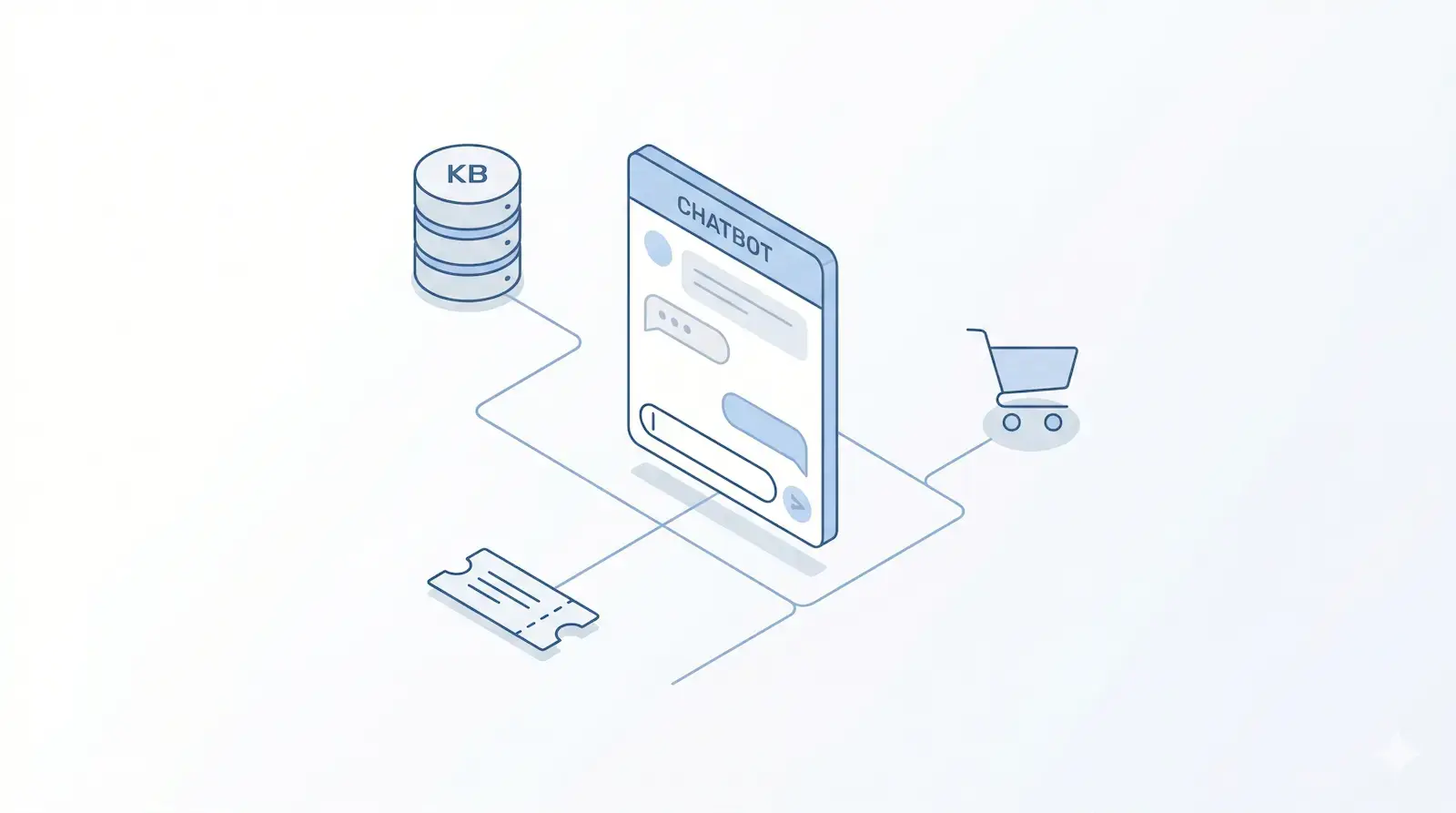
The system is three n8n workflows: the main agent, the WooCommerce order lookup, and the HelpScout ticket handler. The agent calls the other two as tools, so each one can be tested and updated on its own. Product catalog and FAQ content live in separate Pinecone indexes because they change at different rates and should never be confused with each other in retrieval.
The original build ran on GPT-4o. Answer generation has since moved to Claude; embeddings stay on OpenAI. The retrieval design did not change.
The technical walkthrough, including the prompt rules that force the retrieval call and the index separation, is in How I Built a WooCommerce RAG Chatbot with n8n.
Stack
- Orchestration: n8n
- Answer generation: Claude (originally GPT-4o)
- Embeddings: OpenAI
text-embedding-3-large - Vector database: Pinecone (two indexes: products, knowledge base)
- Integrations: WooCommerce REST API, HelpScout API, Google Sheets