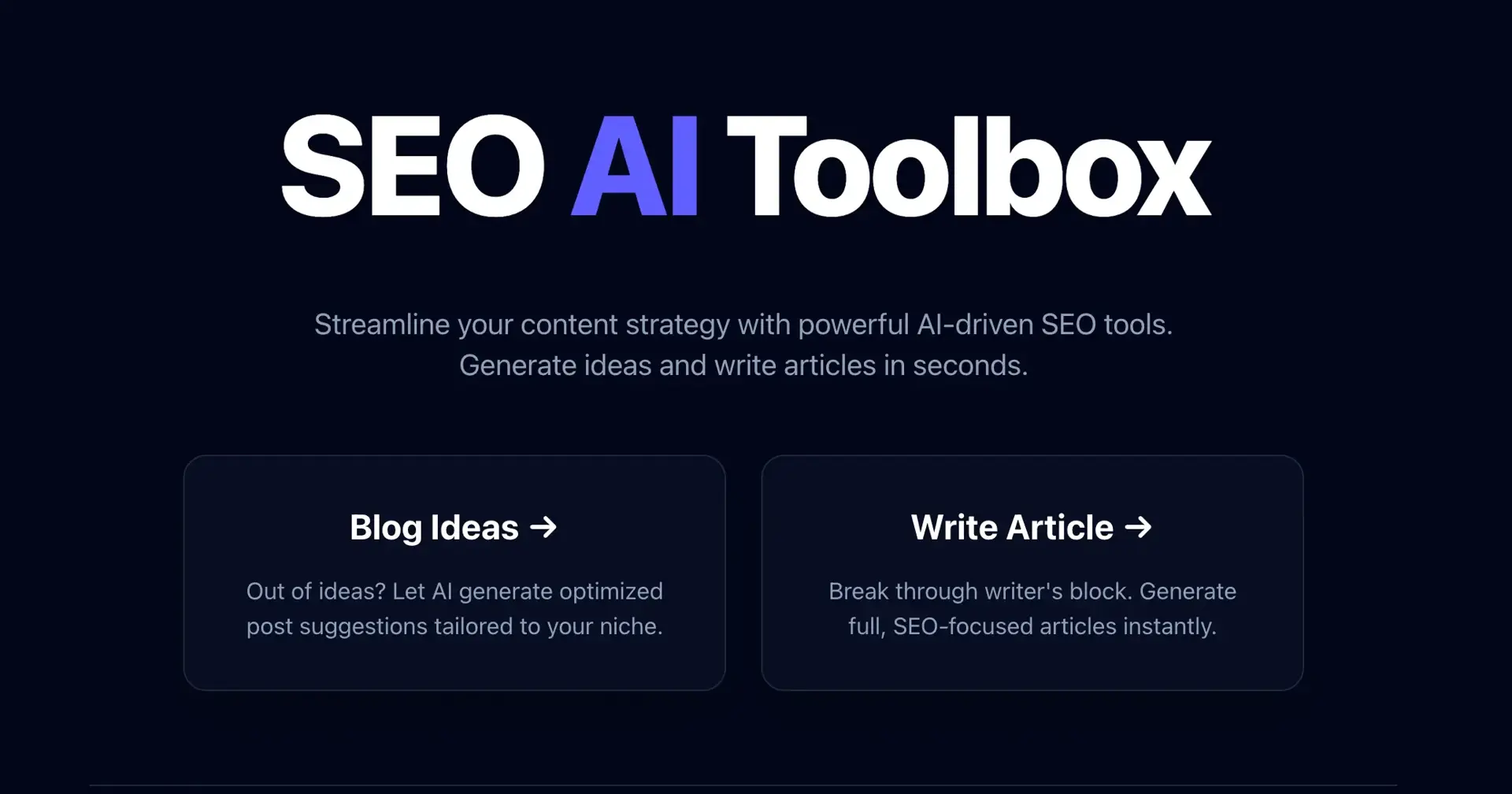
SEO AI Toolbox: Six Small AI Tools for SEO Work
A free set of six OpenAI-powered SEO tools, started in April 2023 to test what the API could really do and kept running through three model generations.
On April 5, 2023, the first commit of this project called GPT-4. The next day it called text-davinci-003, with a commit message that says everything: "AI downgrade version for speed reasons."
That's the whole project in one diff. I built the SEO AI Toolbox to find out what the OpenAI API could do for everyday SEO work, and the first thing it taught me was that the best model is useless if people close the tab while it thinks.
The problem
In early 2023 everyone was pasting prompts into ChatGPT to get blog ideas and meta descriptions. The results were fine. The workflow wasn't: every task started from a blank chat, the prompt changed every time, and nobody could share "the prompt that worked" with a colleague.
I wanted to test the opposite approach. Take each small, repetitive SEO task, give it one fixed prompt with a narrow job, put a form in front of it, and let anyone use it for free. If the API was good enough, a person with no prompting skills would get consistent output. If it wasn't, I'd see exactly where it broke.
How it's built
The first version had two tools, blog title ideas and full article drafts, on Next.js deployed on Vercel. In May 2023 I moved every API route to the Edge runtime and started streaming the response as it's generated. Staring at a spinner until a full article is done feels broken. Watching the text appear as it's written feels fast, even when the total time is the same.
Today it has six tools:
- Blog title ideas for a site and its subjects
- An article writer
- Meta descriptions (three options at 150–160 characters)
- Long-tail keywords, with search intent, in a table
- Image prompts for Midjourney, DALL-E or Stable Diffusion
- Competitor gap analysis for a topic
Each tool has its own system prompt and its own token budget, from 300 tokens for meta descriptions to 1,500 for articles. That cap is the cost control. The model moved from text-davinci-003 to GPT-4o in May 2024 and to gpt-4o-mini in 2026, which keeps the site cheap enough to stay free. If no OpenAI key is configured, it falls back to OpenRouter with a free model, so a copy can run without a paid key. Results can be copied or downloaded as Markdown or PDF.
What it taught me
The narrow tools are the good ones. A meta description, a keyword table or ten title ideas is short output that a person can judge in five seconds, keep what works and throw away the rest. For that kind of work a small, cheap model is more than enough.
The article writer is the weakest tool. Give any model 1,500 tokens and "write an SEO-focused, engaging article" and you get something that reads like every other AI article on the topic, because it has nothing of yours to work with. It's useful as a first outline. It is not a finished post.
That's why I don't let AI write articles for clients, and why the tools I build now, like WP-AutoInsight, keep a human deciding what gets published.
Revived with Gemini CLI in 2026
In early 2026 I used Gemini CLI to bring this codebase and the Choose Your AIdventure game up to date: refactored architecture, updated dependencies and new features, done in spare time between client work. I wrote about how that went in "With Gemini CLI, I'm able to keep my pet projects alive and kicking", which DEV picked as one of the five winners of its Built with Google Gemini Writing Challenge in March 2026.
The toolbox is still online and still free.
What would you add as tool number seven?